Public
Art of the WPA
During
the New Deal, the United States government provided jobs for millions of
starving Americans. For the most part, these jobs entailed work on
some form of civic improvement. There were many artists among those
put to work in the public sector. The thinking behind the employment
of so many artists during a time of such severe economic crisis was that
all Americans, not just the rich and social elite, needed to be familiar
with the arts for America to be truly democratic. Thus, many artists
found work painting murals in public places such as post-offices, jails,
schools, and gyms. Prior to the New Deal, most Americans had never seen
an original painting. The original art of the New Deal that was placed
in public places allowed people of all socio-economic backgrounds and from
all areas of the country access to original art.
The examples below were chosen for their participation in one or more prevalent
themes of the Depression era. Although many of these paintings may
seem bland or insignificant, it was not so at the time of their creation.
While the realism of these pieces is commonplace today, it was likely to
have been the subject of controversy during the Depression era. Moreover,
what may seem like unimportant subject matter to us, such as farmers or
men working in a factory, was rather important during a time when everyday
life was so very connected to working or finding work. Further, the
fact that such subjects were of great importance provides us with a wonderful
idea of the "flavor" of the era in which these works were produced.
Hollis Holbrook, "Reforestation," Haleyville,
Alabama.
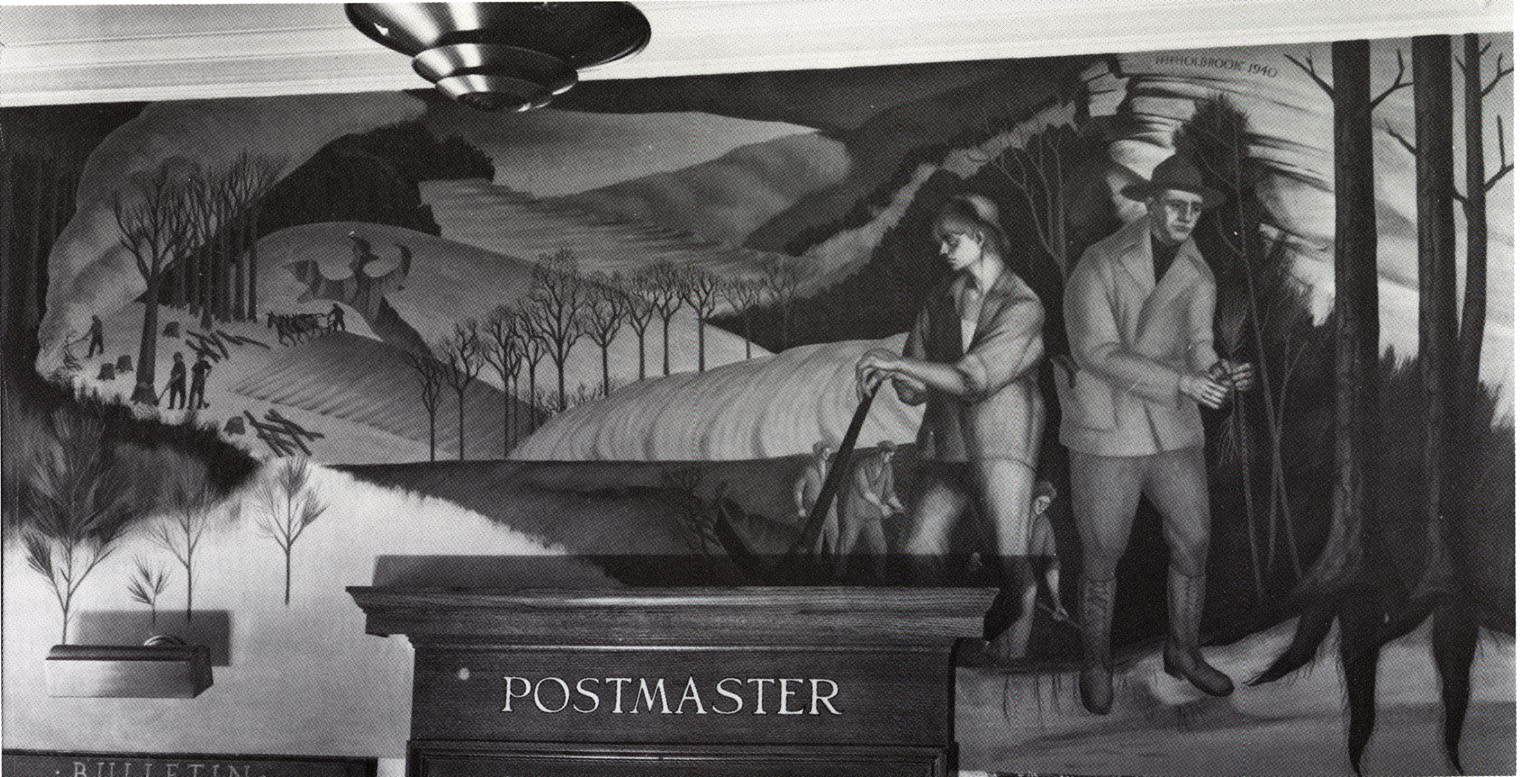
As mentioned before, a common theme
of the WPA/FAP art found in public places was the relation of people to
their work. This particular mural participates more specifically
in a series of paintings on farmers and erosion and conservation of the
soil. Again, the highly practical aspect of art is demonstrated here
as this painting could have served as advice for farmers who would have
seen it in the post office. The painting contrasts the practices
of the CCC and a forest ranger in the right foreground with "unscientific"
farming and the resulting erosion in the left background. The artist,
Hollis Holbrook, said of this painting: "After viewing the country
and seeing it laid bare to deep gashes caused by erosion and thinking about
the future of those who would follow this generation and have nothing,
no soil, to work an knowing that it takes generations to bring back the
soil, I cannot but feel that a kindly interpretation of soil conservation
might be helpful to those people."
Jac T. Bowen, "Industrial Activity
in the City," Higginsville, Missouri.
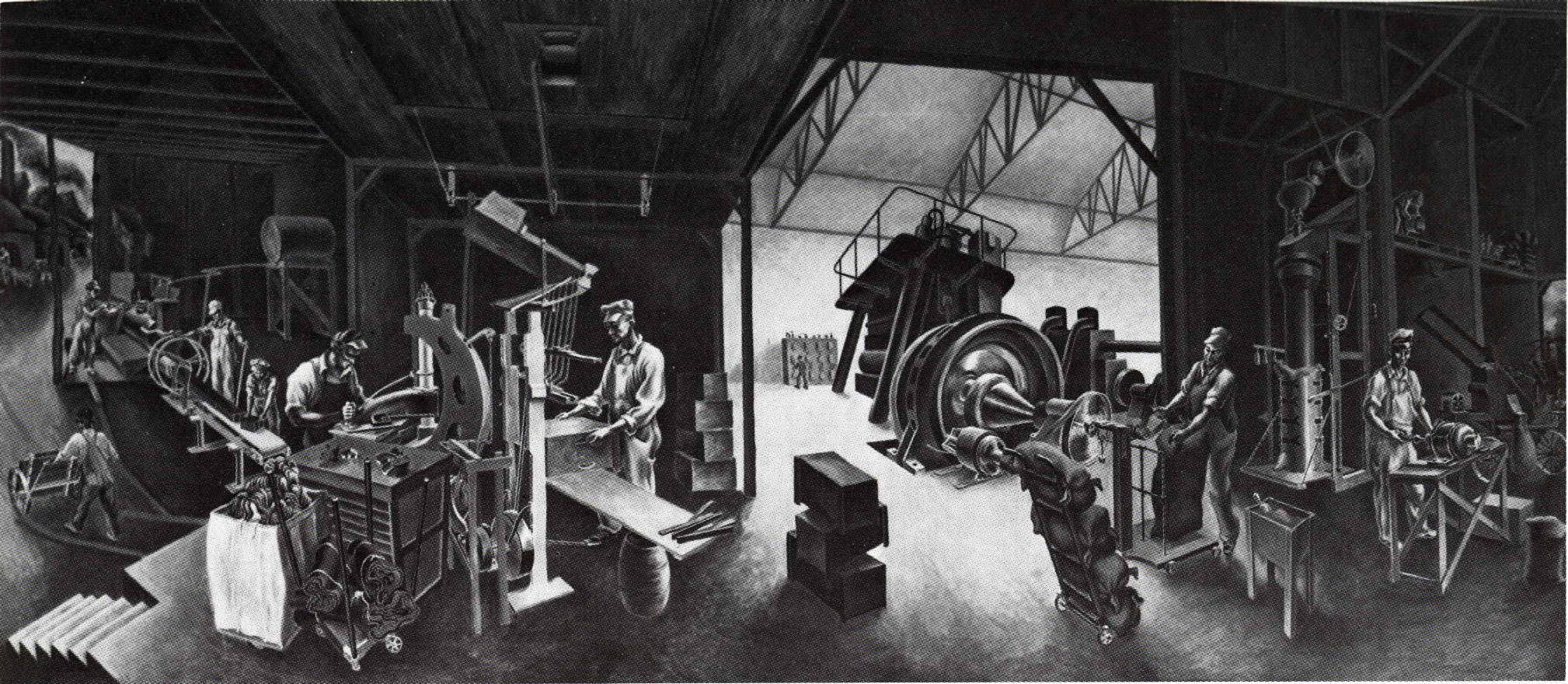
Work is again an important theme here.
According to Jac T. Bowen, the artist, "The people of Higginsville are
workers, not players. Therefore, the important sides of their lives
is their work, of which they are proud." This mural is an excellent
illustration of the New Deal motto "Work makes America." Although
murals depicting the work of industrial America typically illustrated the
workers as heroes, this mural deviates somewhat from this theme by making
the machinery larger than the workers. It does, however, like many
of the murals it differs from, exclude the town. Bowen comments,
"Work made the town--work is building the town-- and work will be the theme
of their future".
Nicolai Cikovsky, "The Old Tavern,"
Silver Spring, Maryland.
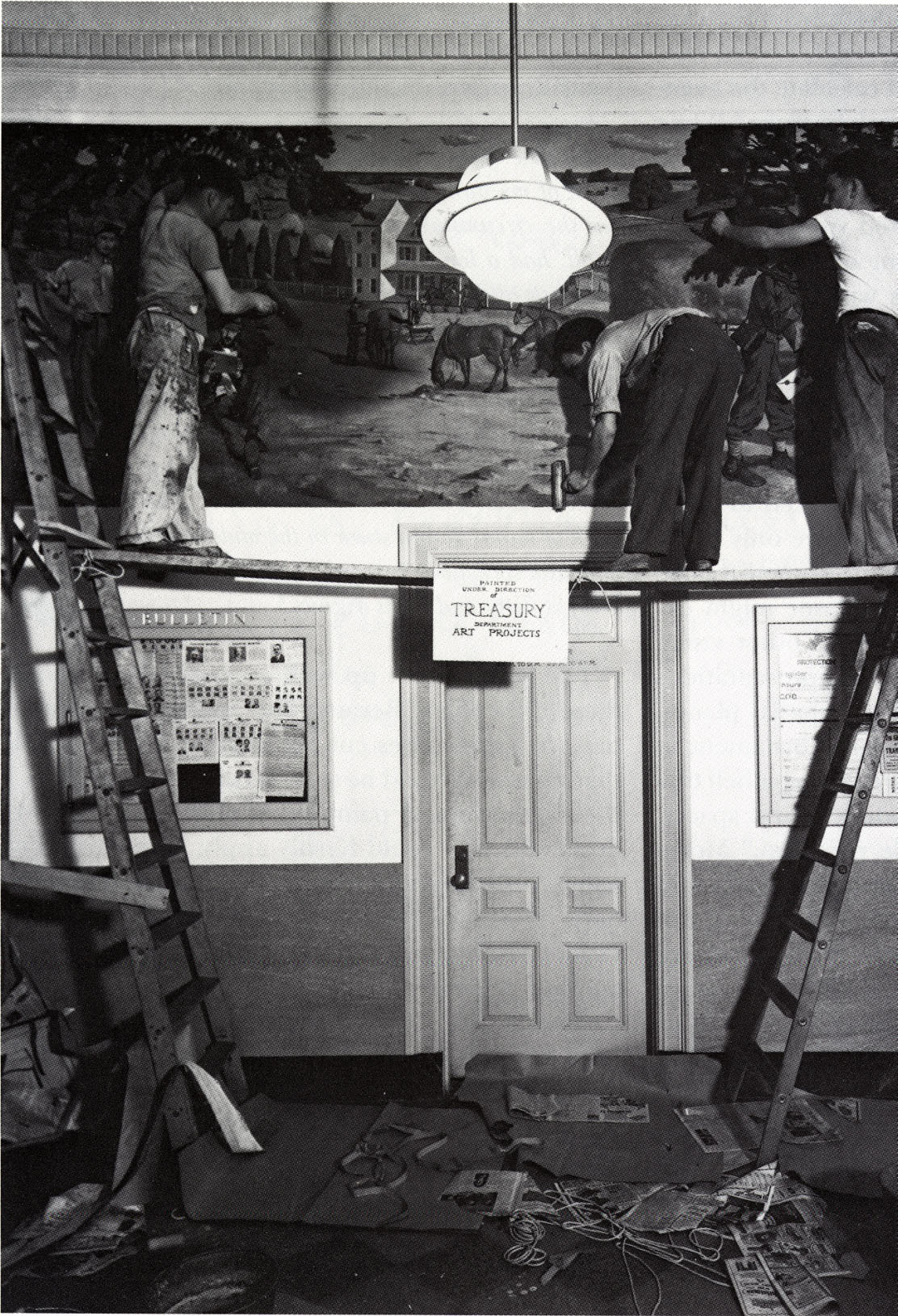
The artist of the WPA murals were
limited. Ideally the artist would work directly on the wall that
would have the mural. Most artists, however, were forced to work on canvases,
referring to blueprints as they worked. These canvases were later
attached to the wall (as above) and in fact, many artists never saw their
work in its final form.
Stephen Etnier, "Mail for New
England," Boston, Massachusetts.
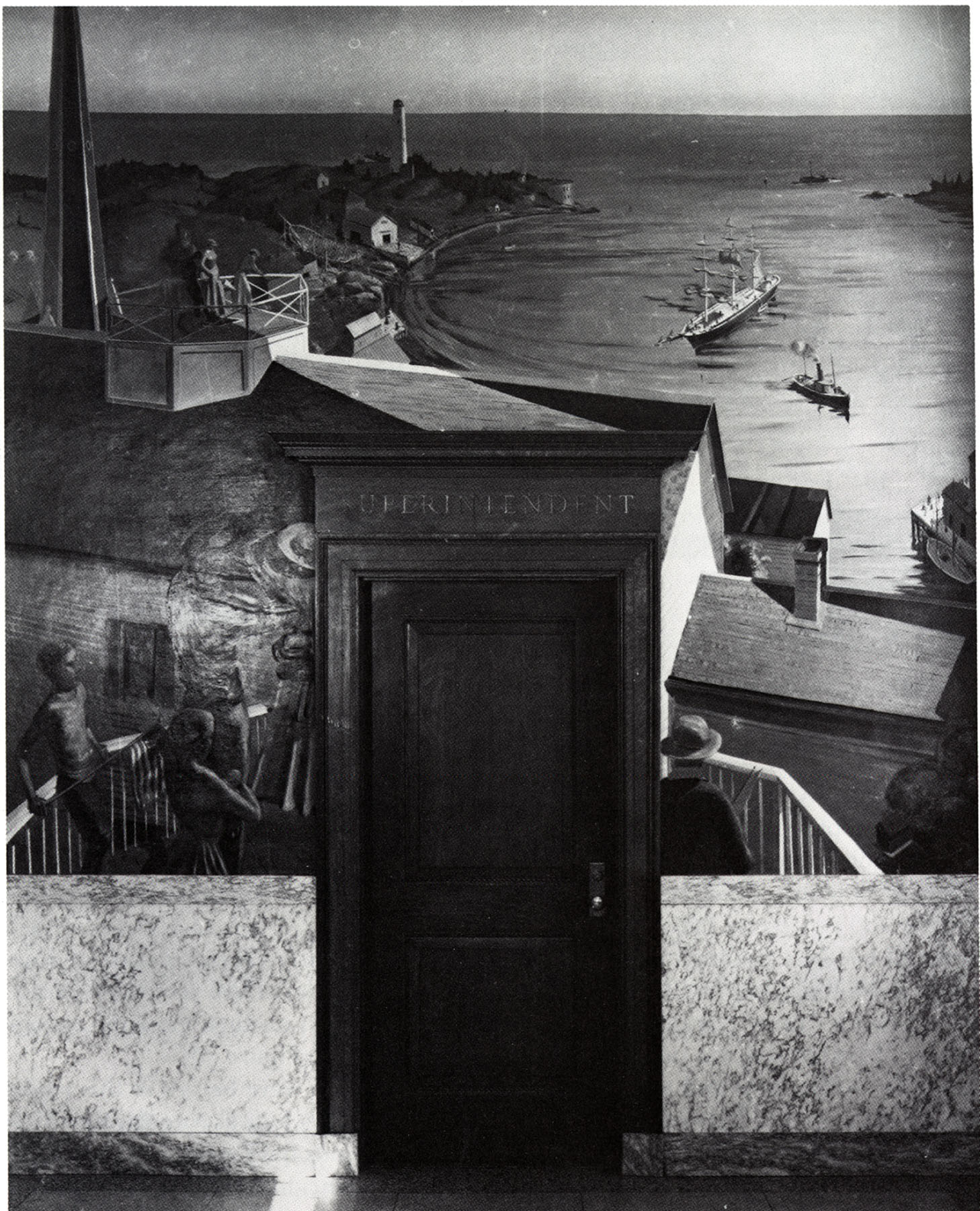
Thematically, the murals of the WPA also
participate in regionalist categories. The murals of New England,
for instance, typically exhibit a diversity of both historical and contemporary
scenes of industry and agriculture. Some murals, like the one above,
present the viewer with scenes of the beauty of New England. The
harbor in the background is set against the scene of the mail in the foreground.
Back to
WPA Art
All information
from this section was drawn from:
**Park, Marlene and Gerald E.
Markowitz. Democratic Vistas: Post Offices and Public Art in the New
Deal.
Philadelphia: Temple University
Press, 1984.