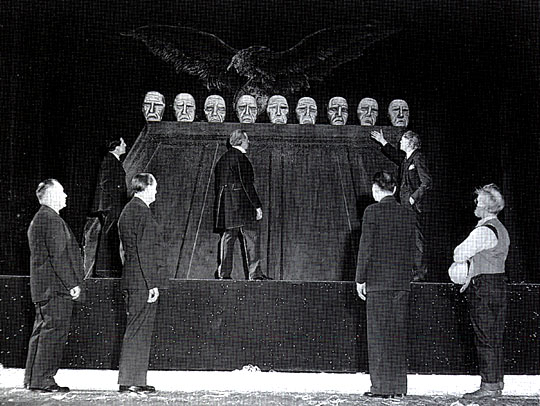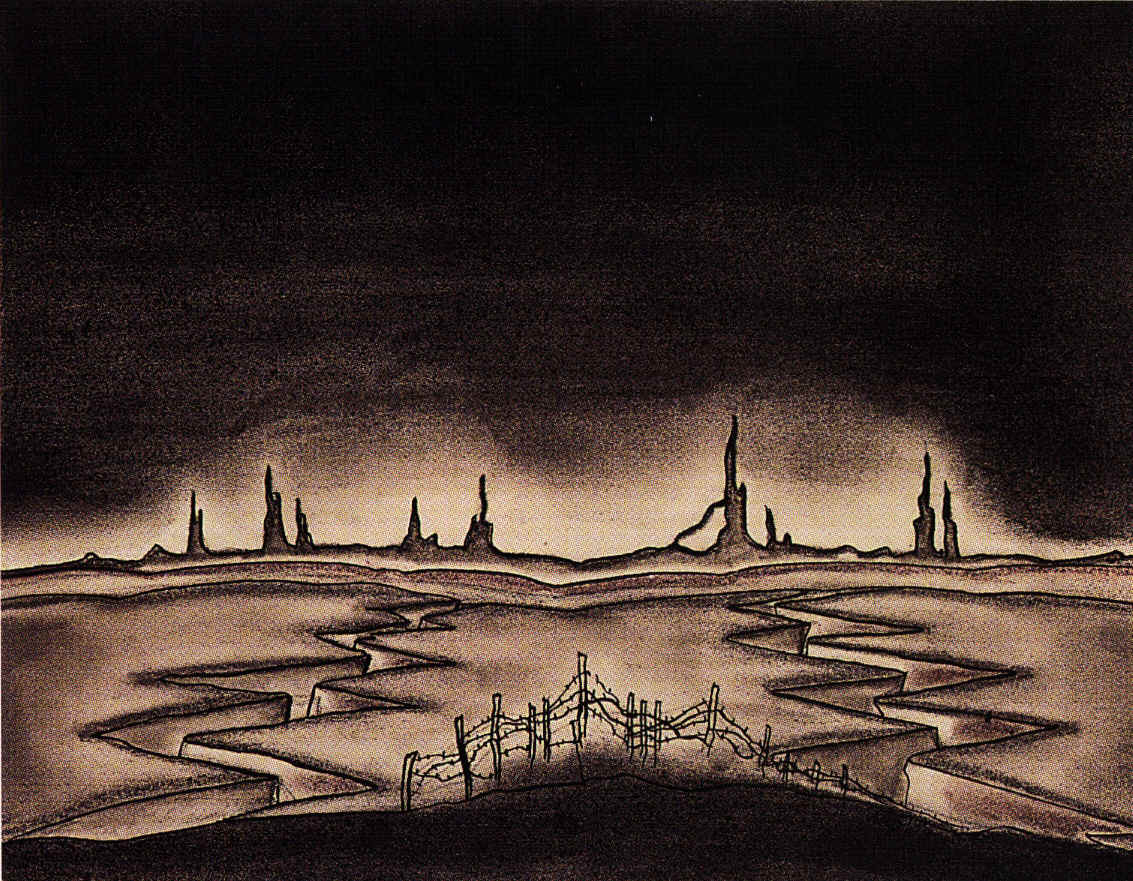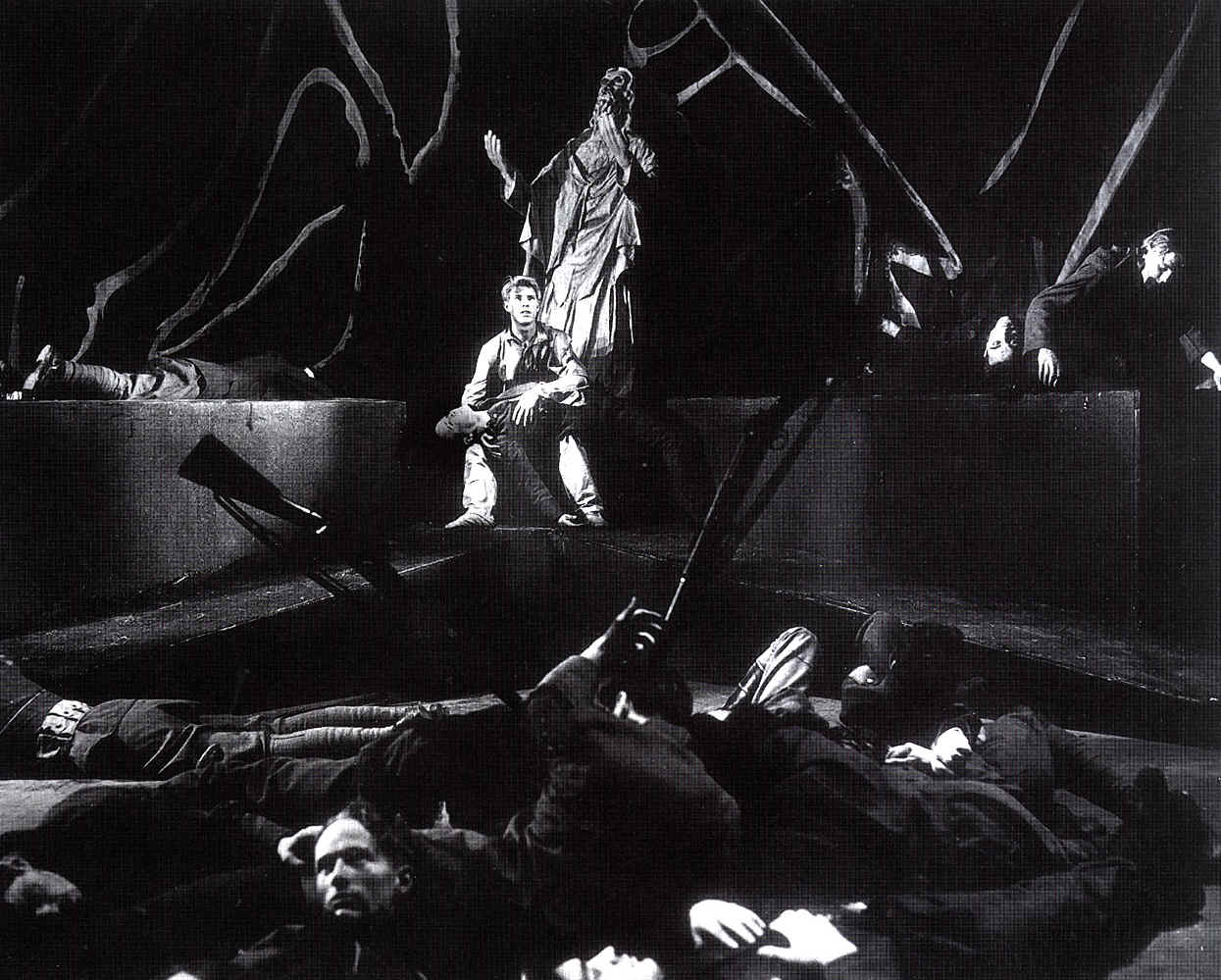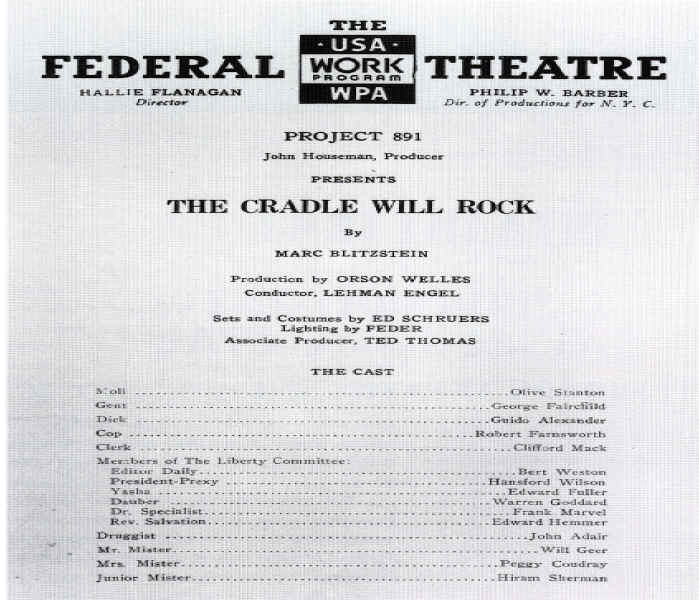
Like the other WPA/FAP programs, the Federal Theatre Project was intended
to provide socially relevant work to starving citizens as an alternative
to bread lines and hand-outs. During its four year life span, the
FTP provided jobs for 13,000 theatre artist in 31 different states.
Just as the well known murals of the WPA brought original art to a people
that had previously had no contact with such things, the FTP brought theatre
to an audience which was, for the most part, wholly untouched by commercial
theatre. Thus, the goal of the New Deal to bring art and culture
to people of all socio-economic levels and of all regions was fulfilled
in the FTP.
But the FTP has an even greater importance to the contemporary American
theatergoer. Many viewed the FTP as the first step toward the creation
of a national theatre like those in European nations where monarchical
patronage had been replaced by a municipal patronage. The vision
of a national theatre, however, was never fulfilled. The tone set
by the abolition of the FTP and other WPA art programs set the precedent
for the role that the government would play as a non-patron of the arts
that still endures today as the NEA is slowly whittled down towards nonexistence.
Despite the absence of a federally subsidized national theatre program
today, the legacy of the FTP remains. The opportunity for unification
of theatrical art in America that the FTP provided caused what had previously
been a scattered and regional art form to coalesce and refigure itself
as a national art. Many of the great American theatrical artists
found a start in the FTP. Among them were Joseph Cotton, Jules Dassin,
John Huston, Burt Lancaster, Joseph Losey, Arthur Miller, Nicholas Ray,
and Virgil Thompson.
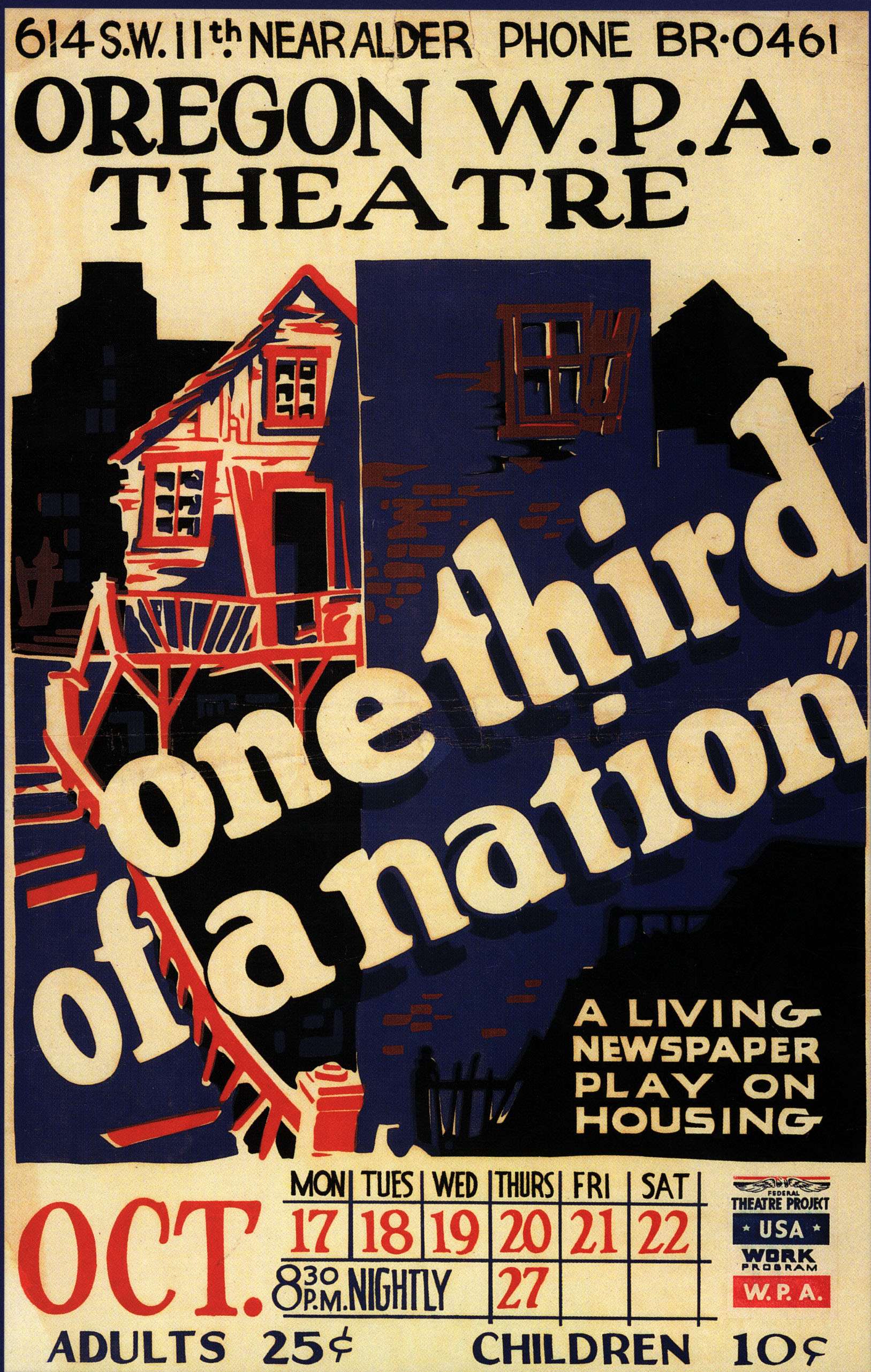
The FTP also exhibits the juxtaposition of artistic and practical concerns
that was common to WPA/FAP art. The FTP made its social contribution
in the form of "Living Newspapers" or theatrical performances that addressed
social issues ranging from housing problems to syphilis. The function
of the Living Newspaper demanded that it be more flexible than conventional
drama. In order to adjust to social conditions that were in flux and successfully
disseminate its propaganda to a geographically vast region, the Living
Newspaper adopted a brief and mobile form.
Thus,
the FTP provides us with what is arguably the most enduring legacy of the
WPA/FAP as well as yet another illustration of the way American culture
was rendered necessarily pragmatic during the Depression era.