 The
twenties were over. The decade of economic profusion and social decadence
had come to a screeching halt with the Wall Street crash of 1929.
Americans found themselves living in a world of financial hardship and
uncertainty that would have been unimaginable less than a decade before.
Despite unprecedented poverty levels and the resulting fear of violent
social unrest, Franklin D.Roosevelt's "New Deal" administration succeeded
in winning the hearts and confidence of the American people. The
essence of the New Deal was putting people to work.
The
twenties were over. The decade of economic profusion and social decadence
had come to a screeching halt with the Wall Street crash of 1929.
Americans found themselves living in a world of financial hardship and
uncertainty that would have been unimaginable less than a decade before.
Despite unprecedented poverty levels and the resulting fear of violent
social unrest, Franklin D.Roosevelt's "New Deal" administration succeeded
in winning the hearts and confidence of the American people. The
essence of the New Deal was putting people to work.
This page is an attempt to provide a brief overview of the art produced
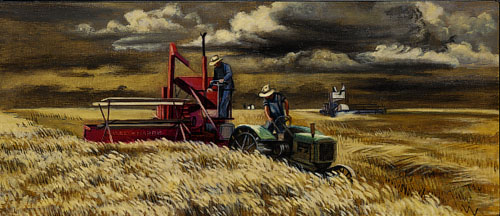
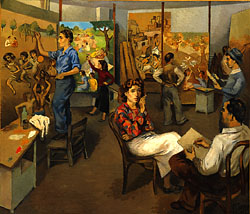
during the New Deal in America. This art is most often categorized
as art of the WPA(Works Progress Administration) or of the Federal Art
Project, also known as the FAP. Today, WPA/FAP art is frequently
ignored or forgotten by the critical community because of its conceptual
distance from the ruling aesthetic of the time. That is to say that
the mostly realistic work produced under WPA/FAP auspices was far removed
from abstract expressionism. It is exactly this removal from the
mainstream, however, that makes this art significant. For my purposes,
WPA/FAP art serves as an index of the practical, down-to-earth "flavor"
of the Depression Era.
Although the art of this period is extremely ecclectic in form, this page
will focus on three main areas of concern:
1. public art- although all of the art sponsored by the WPA was considered public, this section focuses on murals that were dispayed in public areas such as post-offices and schools
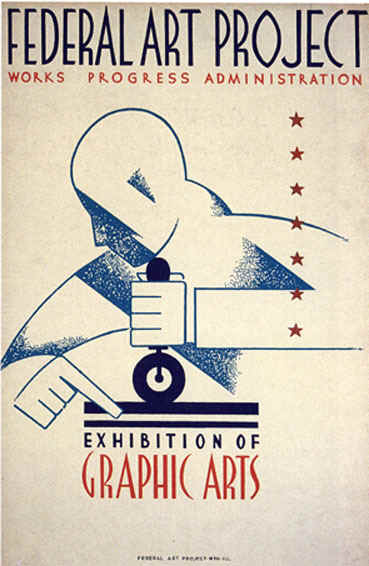
2. posters- another pragmatic way in which artists were employed was the creation of posters with public service messages
3. theatre-
this is the most interesting area
to me as a theatre artist myself. This area contains posters, photographs,
and scenic sketches from the Federal Theatre Project
Although the art of the WPA/FAP has traditionally been ignored by critics, this art is vastly important to an understanding of the spirit of the Depression era and particularly of the New Deal. Again, its existence outside the artistic mainstream and failure to participate in popular movements does not place it outside the realm of importance, but actually emphasizes its importance and relevance as a distinctly American artistic phenomenon. As a result, the art of the WPA/FAP and its history helps us understand not only the rather practical and down to earth spirit of the thirties in America, but also the present day relationship of government to the arts. Even more importantly, however, I believe that the WPA/FAP may provide a model or an ideal that today's legislators can look to for guidance on issues of government and the arts. It is important to note that during the toughest economic times this country has ever witnessed, the U.S. government made refined culture a priority. It is also important to note the benefits of providing arts for all areas and classes of the U.S. What would American art be today had it not been for the WPA?